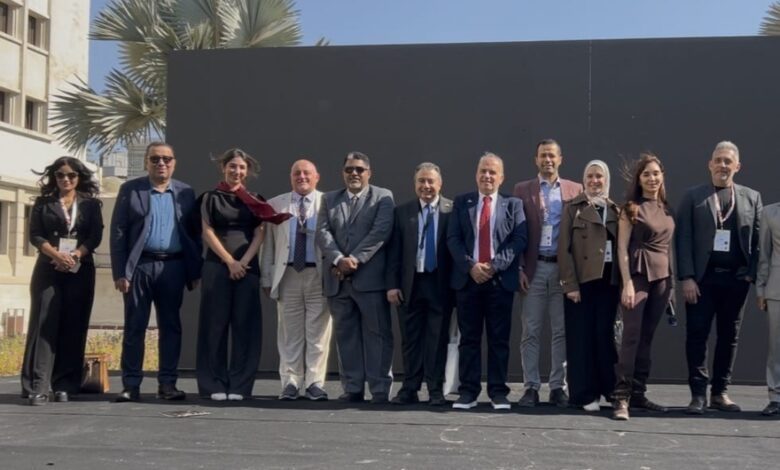
200 Architects from Around the World Gather in Cairo for the American Institute of Architects’ Annual Conference, “Layers of Civilization”
Edit : maher badr
Roger Scaife: Egypt’s Exceptional Architectural and Civilizational Heritage Makes It a Key Destination for Global Architectural Dialogue
Ehab El-Habak: Understanding Successive Civilizations Is Key to Urban Development; Raya Al-Ani: Egyptian Architecture Is a Source of Inspiration for New Generations of Architects
The annual conference of the American Institute of Architects (AIA), Middle East Region, kicked off today at the American University in Cairo, bringing together approximately 200 architects from around the world to explore how successive civilizations have shaped architecture, cities, and urban planning.
Held under the theme “Layers of Civilization,” the conference features a series of specialized seminars and lectures examining the relationship between cultural heritage, architectural identity, and the evolution of urban environments.
Roger Scaife, President of the American Institute of Architects, emphasized the significance of holding the conference in Egypt, describing it as one of the world’s most prominent countries in terms of its rich architectural and civilizational heritage, which spans thousands of years.
He noted that Cairo provides an exceptional setting for discussions on the relationship between civilization and architecture, offering valuable lessons and perspectives from the Egyptian experience to architects worldwide. He added that Egypt’s hosting of this international gathering provides an important opportunity to exchange expertise and strengthen cooperation among architects representing diverse cultures and architectural schools.
Ehab El-Habak, representative of the American Institute of Architects’ Middle East Region in Egypt, said that the American University in Cairo’s hosting of this international event highlights the important role academic institutions play in promoting architectural and cultural dialogue. It also provides architects from around the world with an opportunity to exchange expertise and explore diverse architectural experiences, raising awareness of the importance of cultural heritage and its relationship with modern architectural development.
El-Habak explained that the conference aims to highlight the influence of different civilizations on the identity and architectural character of cities. He stressed that successful and sustainable urban planning requires a thorough understanding of a city’s architectural history, the successive civilizational layers that have shaped it, and their impact on its urban fabric and cultural identity.
He added that these historical and cultural dimensions should serve as fundamental considerations for governments and urban planning authorities when developing their visions and strategies for city development.
El-Habak pointed out that selecting Egypt to host the event carries particular significance, given its unique architectural and civilizational legacy spanning thousands of years. Egypt offers a wealth of examples illustrating the evolution of architecture, construction techniques, and urban planning, from ancient Egyptian civilization through the Greek, Roman, Coptic, and Islamic periods, extending to Mamluk and Ottoman architecture and other historical eras that have shaped the country’s distinctive architectural identity.
Meanwhile, Raya Al-Ani, a member of the Board of Directors of the American Institute of Architects and an Iraqi architect, said that Egyptian civilization represents an exceptional model in the evolution of human architecture, reflecting a remarkable diversity of architectural styles, designs, and engineering solutions that demonstrate human ingenuity and creativity across the ages.
She explained that studying this architectural legacy and exploring its details offers architects an opportunity to draw inspiration for contemporary design, while preserving cultural identity and benefiting from the accumulated knowledge and experience of different civilizations.
El-Habak further noted that the American Institute of Architects is committed to advancing professional standards through organizing international conferences and events that enable architects to engage with leading experts and specialists from around the world and stay informed about the latest trends and developments in architecture, design, and urban planning.
Such initiatives, he added, help Egyptian architects keep pace with global developments, benefit from international experiences, and apply relevant practices within their professional and local contexts.
He also emphasized that participation in seminars and specialized lectures forms an important part of architects’ continuing professional development. He explained that several professional systems worldwide rely on awarding continuing education and training credits and hours as part of the requirements for renewing professional licenses.
This approach ensures that architects remain up to date with scientific, technological, and professional developments, rather than relying solely on the knowledge and experience acquired during their academic studies or early professional careers.
El-Habak added that exploring Egyptian architecture across its various historical and civilizational periods is a major focus of the conference, given the unique experiences it offers in design, construction, and adapting buildings to their surrounding environment and context.
He noted that examining these architectural examples opens new horizons for architects to identify concepts and solutions that can be incorporated into contemporary designs, striking a balance between preserving cultural identity and meeting the demands of modern urban development.
He also explained that the conference program includes field visits to some of Egypt’s most prominent archaeological and historical landmarks, allowing participants to explore firsthand the architectural characteristics of different civilizations, study their artistic and engineering features, and examine how their elements can inform contemporary architectural thinking.
The visits include several major Egyptian landmarks, such as the Giza Pyramids, the Egyptian Museum, the Sultan Hassan Mosque, the Al-Rifa’i Mosque, the Citadel of Saladin, Al-Muizz Street, and the Bibliotheca Alexandrina.
These visits will give participating delegations an opportunity to explore the diversity of Egypt’s architectural schools and styles and appreciate the historical and cultural richness accumulated throughout successive eras.
El-Habak stressed that these field visits represent an important opportunity for participating architects to discover the close relationship between civilization and architecture, and to understand how historic buildings have preserved their identity, artistic significance, and structural value over time.
He concluded by emphasizing that such experiences further reinforce Egypt’s position as one of the world’s leading destinations for studying architectural history and cultural heritage.